
When 15 Orders Get Cancelled in a Row: What a Delhi Consumer Case Teaches Us About E-Commerce Accountability Published by Bhartiya Law Legal Insights Most…
When 15 Orders Get Cancelled in a Row: What a Delhi Consumer Case Teaches Us About E-Commerce Accountability
Most people expect the odd delivery hiccup when shopping online. But what happens when almost every single order you place gets cancelled, over and over, for months on end, while your family member ordering the exact same item from the same seller receives it without any trouble? A South Delhi consumer went through precisely this, and the case he eventually brought before the District Consumer Disputes Redressal Commission is worth understanding if you have ever felt brushed off by an e-commerce helpline.
A Pattern, Not a One-Off
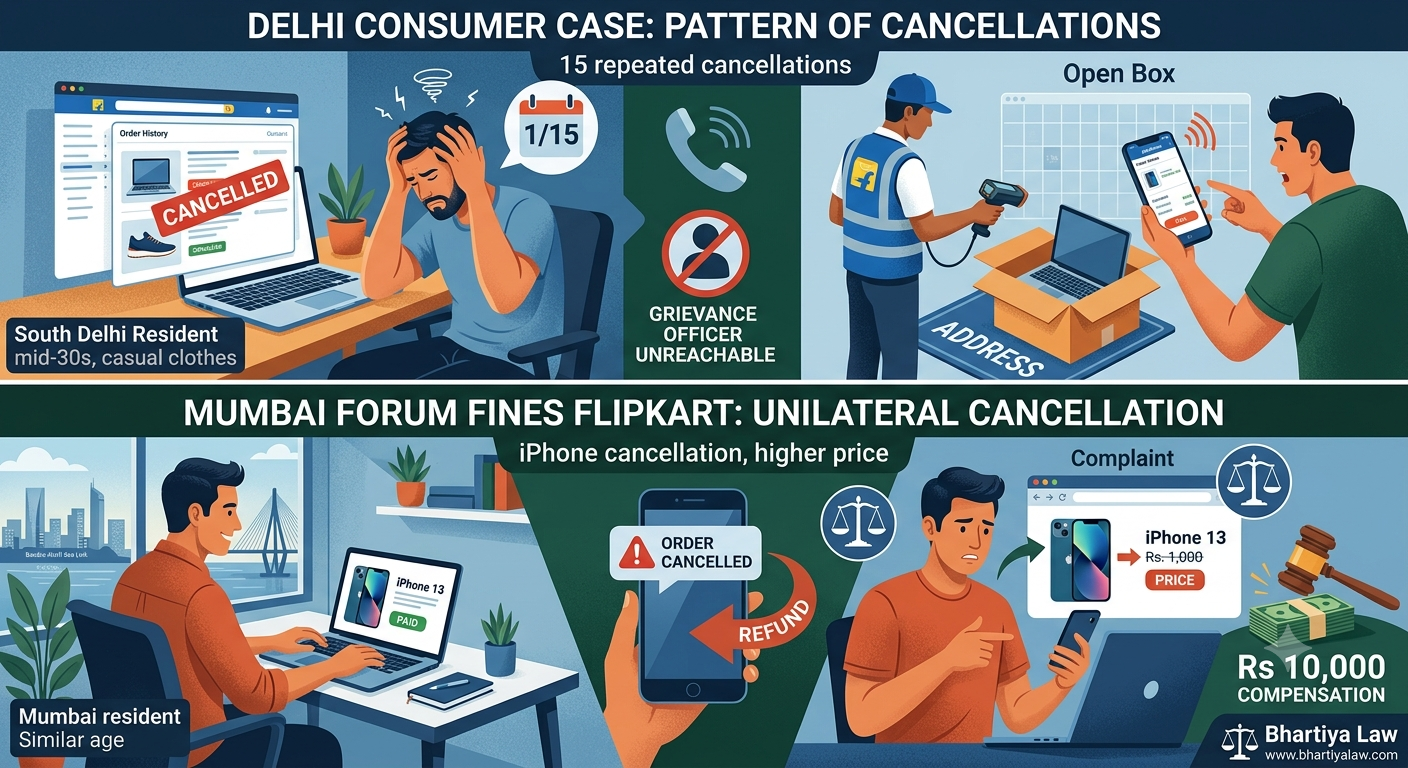
The dispute began with a straightforward shoe purchase in November 2023. The order was confirmed, a delivery date was set, and then, without warning, the complainant received a message saying it had been cancelled, with no reason given. When he called customer care, the representative admitted that the cancellation had happened unilaterally, even though the product was shown as available and in stock at the time the order was placed.
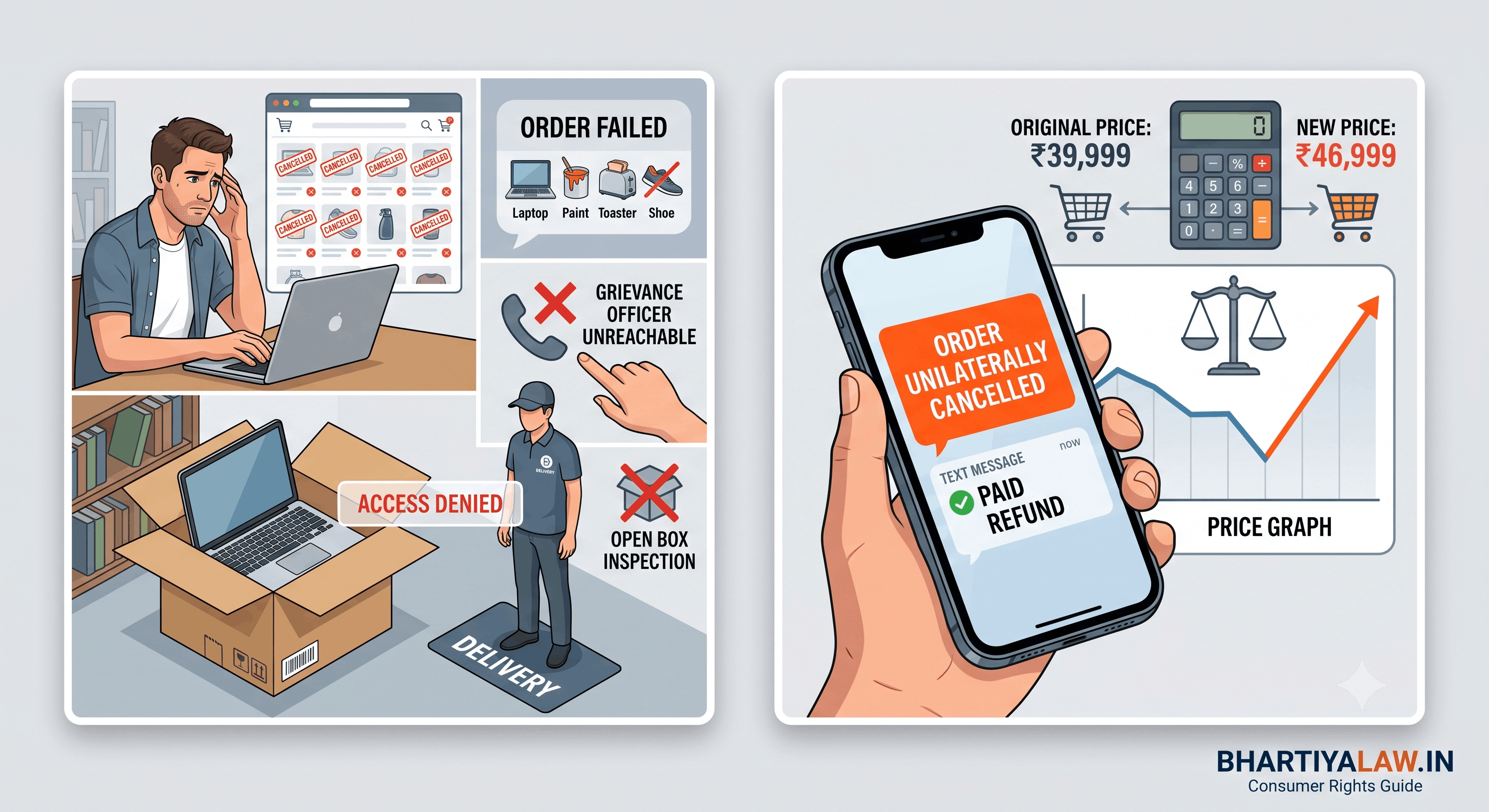
That alone might have been dismissed as a one-time glitch. But it was only the beginning. Over the following months, the same consumer faced cancellation after cancellation across a wide range of purchases, from a bulk paint order to home décor items, a bread toaster, and eventually a laptop. In total, the complaint documented more than fifteen separate instances where confirmed orders were cancelled, often citing vague reasons such as unforeseen circumstances or the courier being unable to locate the address, despite the same address having received deliveries successfully in the past.
One detail stood out in particular. The complainant's brother, living in the very same house, placed an order for the identical product from the identical seller and received it without any issue at all.
Chasing a Grievance Officer Who Was Never Available
Beyond the repeated cancellations, the complainant said he tried multiple times to escalate the issue properly. He asked for the name of the manager handling his complaints and was refused. He then tried calling the Grievance Officer whose number was listed on the platform's own website, only to find the line consistently unreachable.
He argued that this amounted to a clear violation of the Consumer Protection e-Commerce Rules, 2020, which require platforms to make grievance redressal contacts genuinely accessible, not just listed for the sake of compliance.
At one point, after he warned the company by email that he intended to pursue legal action, a representative from the platform's grievance team did call him and offered a token amount as a gesture of goodwill. He declined it as inadequate, pointing out that other consumer commissions had already awarded far higher compensation in comparable cases.
The Laptop That Never Got Delivered
Perhaps the most detailed episode in the case involved a laptop order that came with an open box delivery option, meaning the delivery agent is supposed to open the package on the spot so the buyer can confirm the product matches what was ordered before paying. When the agent arrived, he refused to allow this inspection, insisting it was not possible. The complainant called customer care while the agent was still present, and the representative confirmed on the call that open box delivery was indeed part of the order. Yet once the call ended, the delivery agent cancelled the order anyway and left, refusing even to give his name.
A replacement order was arranged, but this time the platform's website no longer offered the open box delivery feature at all, and the second delivery attempt was refused for the same reason. The order was ultimately cancelled again, with the complainant informed that the company did not want to make him wait any longer, despite the fact that he was the one asking for the product to actually be delivered.
The Platform's Defence
The e-commerce company took the now familiar position that it is merely an online marketplace, an intermediary within the meaning of the Information Technology Act, connecting independent sellers with buyers. It argued that the actual seller in each transaction was a separate legal entity that had not been made a party to the case, and that any liability for cancelled orders or refused deliveries rested with that seller alone, not the platform. It also pointed to its own terms of use, which state that all commercial terms of a sale are agreed between the buyer and the seller directly.
The company relied on prior Supreme Court rulings emphasising the separation between marketplace operators and the sellers who list products on them, arguing this shielded it from direct responsibility.
How the Commission Saw Things Differently
The Commission was unimpressed by this defence. It observed that the platform did not dispute any of the specific factual allegations, the repeated cancellations, the unreachable grievance officer, the refused open box inspection. Its only real argument was that it should not be held responsible because it was not technically the seller.
The Commission rejected that framing outright, holding that an online platform cannot wash its hands of responsibility by simply calling itself an intermediary while it continues to actively control the buying and selling process. It noted that payments were made directly to the platform, that all orders were placed through its website, and that the platform earns fees or commissions from the sellers using it. Given this level of involvement, the Commission found it unreasonable for the company to disclaim liability altogether.
The Outcome
The Commission directed the e-commerce company to pay Rs 10,000 as compensation for the harassment caused to the consumer, with interest at 6 percent per annum if not paid within three months of the order. While the complainant had sought a much larger sum, including litigation costs, the Commission limited the award to this amount and did not grant any further relief.
The Bigger Picture for Consumers
This case is a reminder that persistence matters. A single cancelled order can feel like bad luck, but a documented pattern of repeated cancellations, refused inspections, and an unreachable grievance system builds a far stronger case. It also shows why keeping a paper trail, screenshots of order confirmations, call recordings, dates and times of every cancellation, can make the difference when a dispute eventually reaches a consumer forum.
It further confirms that Indian consumer commissions are not inclined to accept the intermediary defence at face value. If a platform controls payments, order placement, and the buying experience, courts are increasingly willing to hold it accountable rather than sending frustrated consumers chasing after third party sellers who may be difficult to even identify.
Facing Repeated Cancellations or a Non-Responsive Grievance Officer?
If an online platform keeps cancelling your orders without a proper explanation, or if you cannot get a grievance officer to respond, you do not have to simply accept it. Document everything and consider your options under the Consumer Protection Act, 2019. Bhartiya Law can help you evaluate your case and take the appropriate legal steps.