
Paid in Full, Order Cancelled Anyway: Mumbai Consumer Forum Fines Flipkart for Unilateral Cancellation Published by Bhartiya Law Legal Insights Imagine…
Paid in Full, Order Cancelled Anyway: Mumbai Consumer Forum Fines Flipkart for Unilateral Cancellation
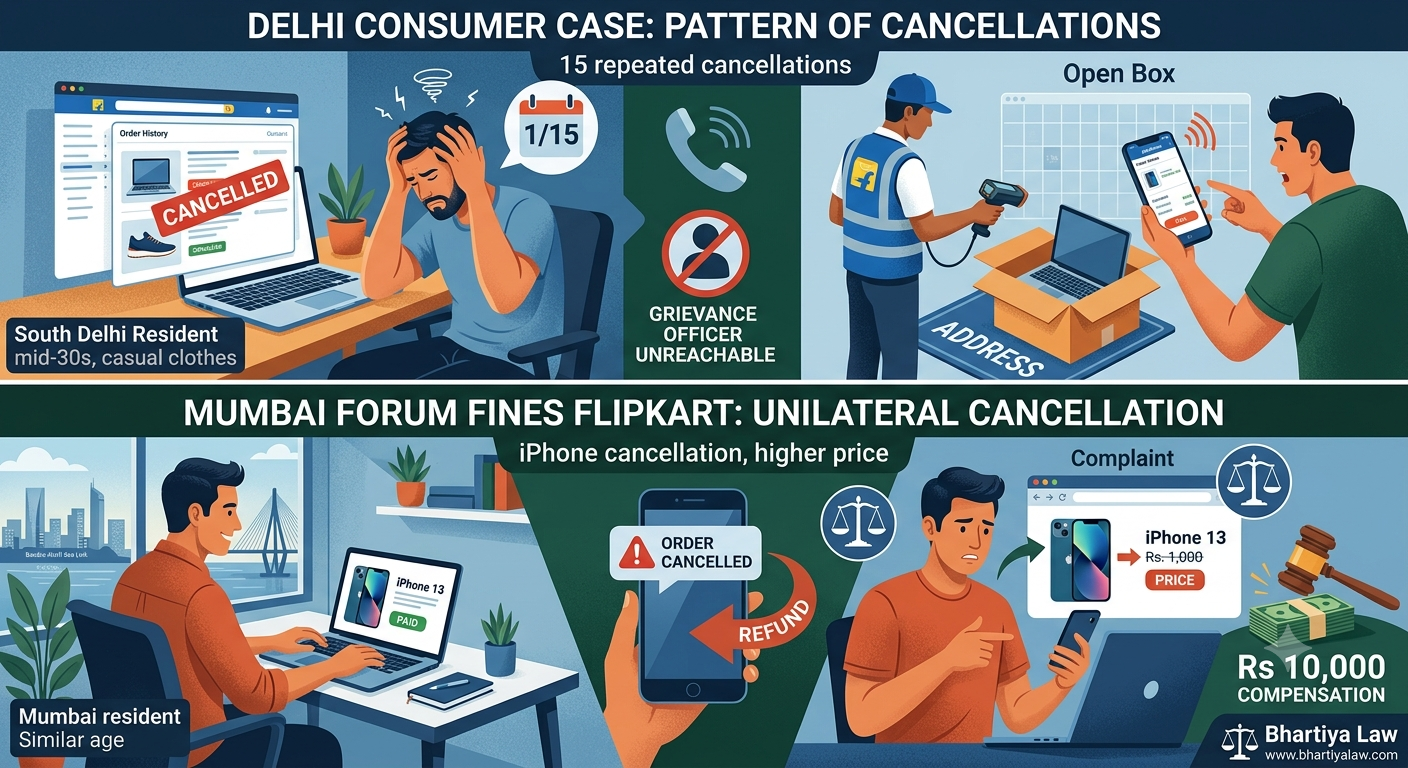
Imagine paying nearly Rs 40,000 for a brand new iPhone during an online sale, waiting patiently for it to arrive, and then getting a text message telling you the order has simply been cancelled. No damaged product, no failed payment, just a cancellation notice and a refund you never asked for. This is exactly what happened to a Mumbai based consumer, and his case against Flipkart offers a useful lesson for anyone who shops online in India.
What Happened
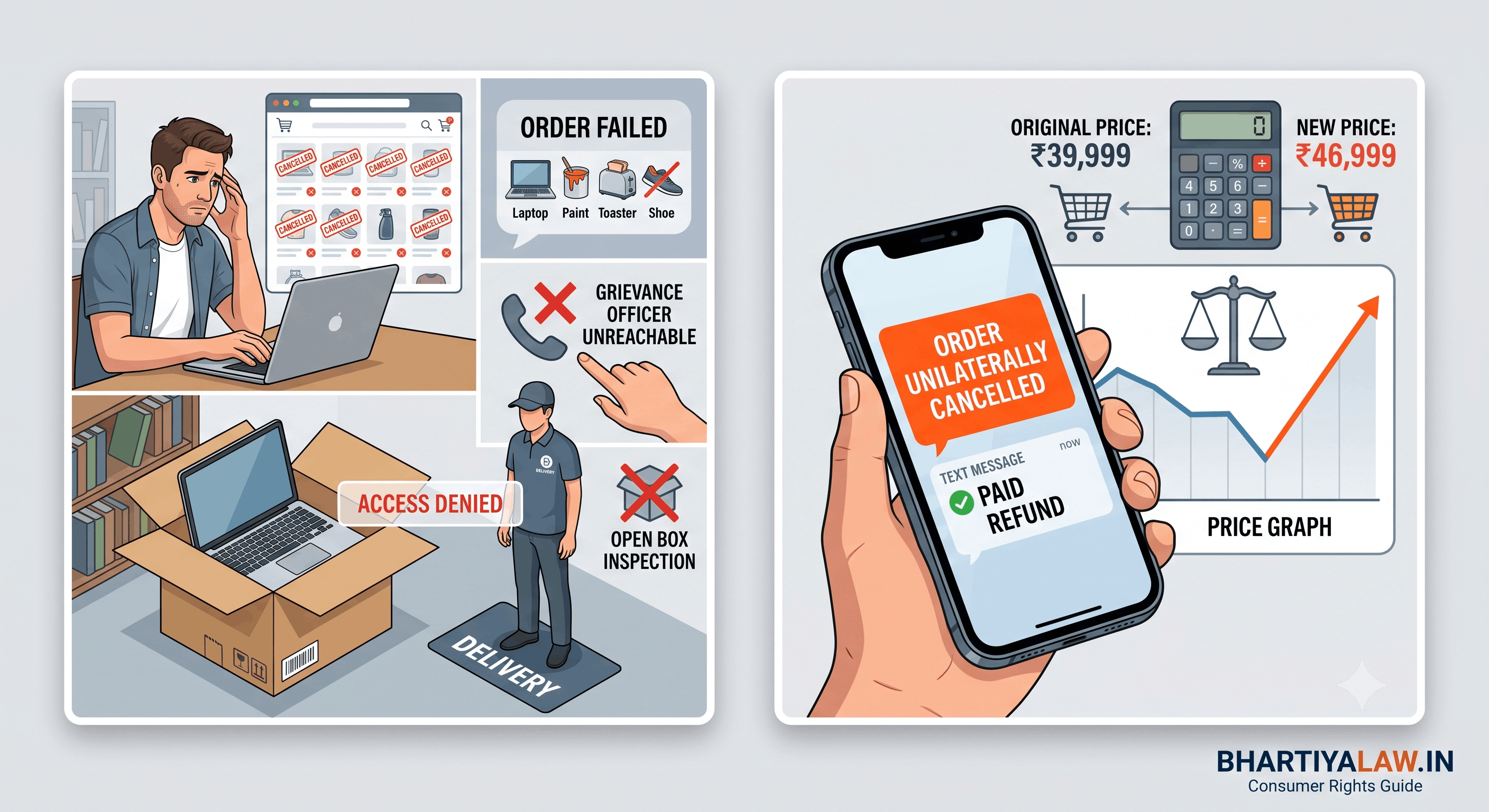
The complainant ordered a mobile phone on Flipkart on 10 July using his credit card and paid the full amount upfront. Delivery was promised within two days, but nothing arrived. Days passed with no explanation, and then he received a message stating that the order had been cancelled because the delivery agent could not reach him.
According to the complainant, that was not the full story. He said the delivery agent came to his home only once, in the afternoon, when he happened to be at work. His father spoke to the agent and asked him to return that evening, which the agent agreed to but never did. The next day, the complainant took leave from his office specifically to be home for the delivery, yet no one showed up or even called.
Frustrated, he approached Flipkart directly and later filed two separate consumer complaints, one against the delivery partner and one against Flipkart itself, before the District Consumer Disputes Redressal Commission in Central Mumbai.
Flipkart's Defence: 'We Are Just the Middleman'
Flipkart's response followed a pattern that has become familiar in Indian consumer courts. The company argued that it merely operates an online platform and does not itself sell any goods. It claimed the phone had actually been sold by an independent third party seller, and that any issue with delivery or cancellation was strictly between the buyer and that seller.
Flipkart also leaned heavily on Section 79 of the Information Technology Act, which shields online intermediaries from liability for content or transactions carried out by users on their platform, along with related provisions of the Consumer Protection e-Commerce Rules, 2020. In short, the company's position was that it could not be held responsible because it was never really a party to the sale.
Why the Commission Rejected This Argument
The Commission was not convinced. A few gaps in Flipkart's case proved decisive.
- First, the company never actually produced any evidence of the third party seller it claimed was responsible. There was no invoice, no communication trail, and no proof that such a seller even existed in relation to this transaction. Every message the complainant received, whether about delivery updates, the cancellation, or the refund, came directly from Flipkart.
- Second, Flipkart's own terms of use had no clause explaining under what circumstances an order could be cancelled after full payment had already been received, or how many delivery attempts would be made before cancellation. Without such terms on record, the Commission found no basis to accept that the cancellation was a routine or justified business practice.
- Third, and perhaps most tellingly, the timing raised questions. The Commission noted that after the order was cancelled, the complainant was simply asked to place a fresh order, by which point the price of the same phone had risen by roughly Rs 7,000. The Commission observed that a genuine delivery failure does not usually coincide so neatly with a price increase, and treated this as evidence that the cancellation may have been used to force a costlier repurchase.
The Ruling
The Commission held that Flipkart, and not the logistics partner, was the entity with a direct consumer relationship with the complainant, since the payment had gone to Flipkart and the order itself was placed on its platform. It ruled that:
- A refund alone does not clear a platform of liability. As the Commission put it, a person who spends time and money buying something online wants the product delivered, not merely their money returned.
- Cancelling a paid order and nudging the customer toward a fresh purchase at a higher price amounted to an unfair and restrictive trade practice.
- Flipkart Internet Private Limited was directed to pay Rs 10,000 as compensation for the mental harassment caused, plus Rs 3,000 towards litigation costs, with interest at 9 percent per annum if the amount was not paid within 45 days.
The complaint filed against the delivery partner, Ekart Logistics, was dismissed, since there was no direct consumer relationship between the complainant and the courier company itself.
What This Means for Online Shoppers
This ruling reinforces a principle that Indian consumer forums are applying with increasing consistency: an e-commerce platform cannot escape responsibility simply by labelling itself an intermediary. If the platform collects the payment, controls the order process, and communicates directly with the buyer, it will likely be treated as the party accountable for a broken transaction, regardless of who technically listed the product.
If you find yourself in a similar situation, here is what is worth doing right away:
- Save every message and email related to the order, the payment confirmation, and the cancellation.
- Note whether the price of the item changes shortly after your order is cancelled. This can be important evidence.
- Do not accept a refund as the end of the matter if you believe the cancellation was unjustified. You may still be entitled to compensation.
- Raise a written complaint with the platform's grievance officer before escalating further.
Need Help With a Similar Dispute?
If an online platform has cancelled your paid order without a valid reason, you are not without options. Consumer commissions across India are taking these complaints seriously, and the law is on the side of the buyer far more often than platforms would have you believe. Reach out to us at Bhartiya Law for guidance on how to draft a legal notice or file a consumer complaint of your own.